The Customer Journey Without the Customer
What do B2C businesses need to rethink as customers hand more of their journey to Personal AI?
The launch of Muse by Meta is a masterclass in positioning.
In a market where ChatGPT has almost become shorthand for the AI-assistant category, Meta did not introduce Muse simply as another place to ask questions.
It gave it a clearer job: Get something done for me.
Book the travel. Fill out the form. Send the email. Negotiate the bill. Find the product. Make the purchase. Come back when you need my approval.
Meta's own positioning is unusually explicit. Muse “doesn't just answer questions, it actually does the work.” It can use a browser, fill out forms, negotiate on a user's behalf, send emails and book travel. For sensitive actions such as making a purchase, it comes back to the user for approval. Meta also says there is no technical experience required and that interacting with Muse works like messaging another person, either in the Muse app or through WhatsApp.
That last part may matter more for customer experience than another improvement in model intelligence. Personal AI agents are not new. What Muse may accelerate is their movement beyond the tech-savvy community. There is no protocol to learn. No agent framework to configure. No need to understand what computer use or MCP means. You tell someone what you want done.
The early consumer response suggests this deserves attention. Sensor Tower estimated that Muse had already reached more than 3.4 million downloads by September 25, barely over two weeks after launch. Estimates of app adoption this early inevitably vary, but the speed of adoption is difficult to ignore. (Ref: TechCrunch).
Whether Muse itself eventually wins this market is less interesting than the behaviour it is helping normalise. For years, CX has been built around understanding and improving the customer journey. Personal AI introduces a new possibility: the customer may increasingly delegate parts of that journey to an agent. Once consumers start delegating outcomes rather than navigating journeys themselves, the structure of customer engagement changes.
The customer may stop navigating the journey
For much of the last decade, one of the most repeated promises in customer-engagement technology has been:
Meet customers on the channels where they already are.
That logic helped push businesses toward WhatsApp, RCS, richer mobile messaging, web chat and increasingly sophisticated digital journeys.
Now consider a customer before a purchase:
Compare this product across these three retailers. Check my email for any discount coupons. Include delivery charges. Buy it from whichever one gives me the lowest final price.
The customer did not visit three websites.
They did not open three apps.
They did not search their inbox.
They did not consciously enter a retailer's acquisition or conversion journey.
They expressed an intent.
The agent worked out the execution.
The same model can extend across the rest of the customer lifecycle.
After the purchase:
Find out why my delivery is delayed and move it to tomorrow evening.
During an ongoing relationship:
Check whether I am overpaying for this mobile plan and find me a cheaper option.
During service:
Find out why my insurance claim was rejected. If they need the invoice, find it in my email and ask where it needs to be submitted.
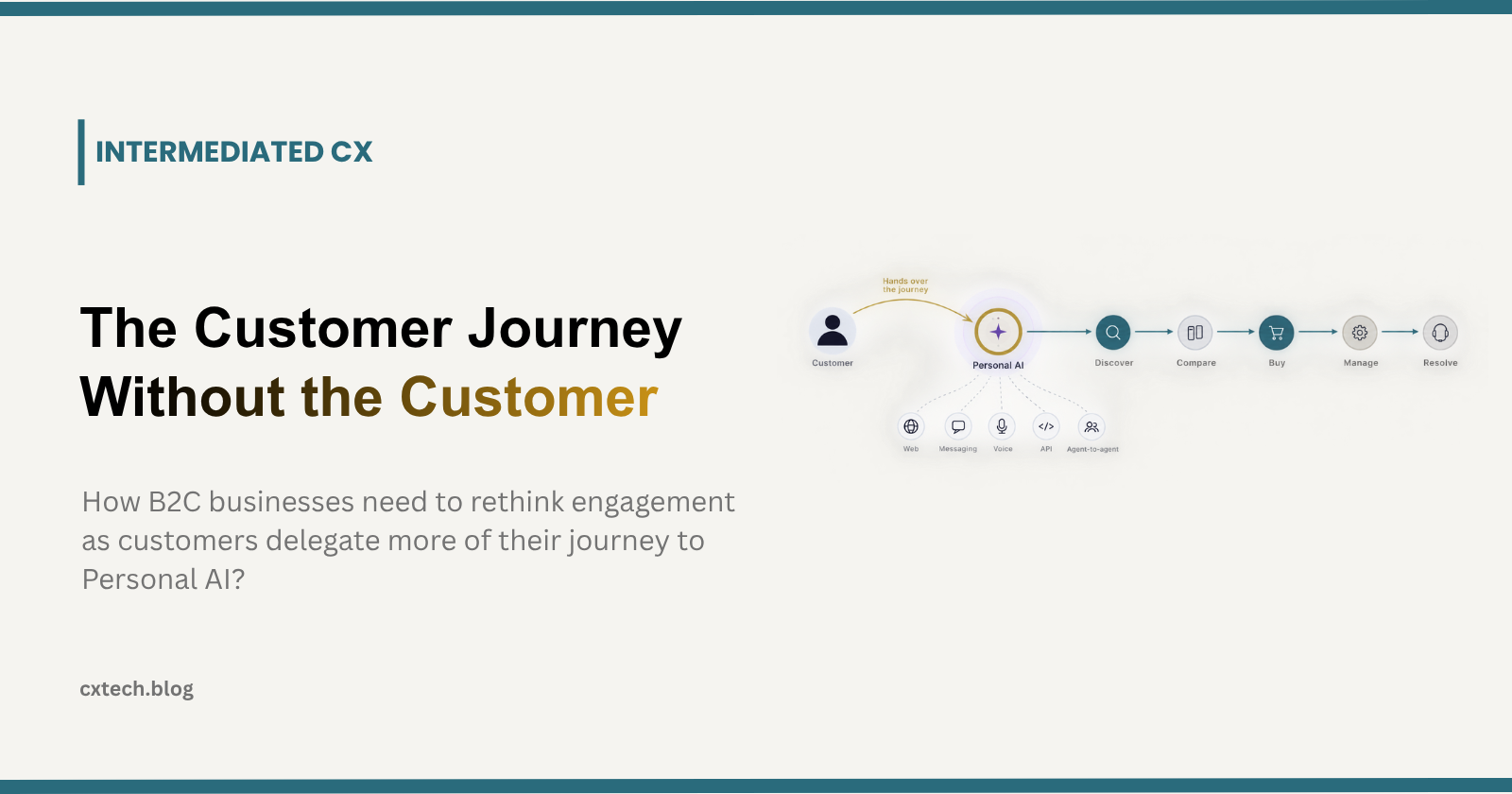
From the consumer's perspective, all of these experiences can happen in the same place. Their personal agent.
The businesses involved may see something completely different.
A website visit.
A voice call.
A chat session.
An email.
An API invocation.
Or, increasingly, a direct interaction between the customer's agent and an enterprise agent.
The interface between intent and execution has moved somewhere else.
That changes the premise underneath marketing, in-life customer engagement and service alike.
The enterprise may see the transport. The customer sees the outcome.
This creates a strange measurement problem.
If a personal agent compares products by browsing your site, analytics sees web traffic. If it contacts you through a messaging channel, your communications platform sees a message. If it calls customer service, your service platform sees voice. If it eventually talks directly to an enterprise agent or invokes a capability through an API, parts of the traditional customer-engagement stack may not see the interaction at all. Yet none of those necessarily describes the experience the customer had.
The customer experienced: “I asked my agent to sort it out.”
A significant shift in consumer behaviour could therefore hide inside familiar metrics. Website traffic may increasingly include software navigating interfaces designed for people. A purchase attributed to search or a referral may have originated from a recommendation made inside an AI interface. Voice volumes may increasingly include personal agents acting on behalf of customers. The transport still tells the enterprise how an interaction arrived. It increasingly tells us less about how the customer experienced it.
That suggests CX teams need another dimension alongside channel:
Who is acting, for whom, and what are they trying to get done?
Much of today's agentic CX is solving a different problem
The CX technology market is moving quickly on AI. But it is worth being precise about which jobs vendors are actually solving.
On the marketing side, much of the innovation is focused on making the marketer dramatically more productive. Salesforce's Campaign Agent can create, run and optimise campaigns within marketer-defined goals and guardrails. Klaviyo's Composer can draft flows, segments and messages from natural-language instructions. BrazeAI Operator provides prompt-driven campaign creation, analysis and hands-on execution inside Braze.
In jobs-to-be-done terms, much of this addresses:
“I know the marketing outcome I want. Help my team create, personalise, execute and optimise it with far less manual work.”
That is useful.
But it is different from:
“My customer's AI is now helping decide which brands to consider, what information to trust and potentially what to buy. How does my brand participate in that experience?”
There is progress on this second problem too. Contentful's Palmata, for example, is designed to help brands understand and improve how AI answer engines such as ChatGPT and Gemini discover and represent them, including before the consumer ever visits the brand's website.
That starts to address:
“Make my brand discoverable and accurately represented inside an AI-mediated buying journey.”
But discovery is only one part of customer engagement. The harder problem starts when the consumer tells their agent to do something.
A similar distinction exists across communications and customer service. Platforms such as Twilio, Genesys and Five9 are investing heavily in company-controlled AI that can interact with customers, retain context, execute workflows, access enterprise systems and escalate when necessary.
Twilio's Agent Connect, for example, is generally available across Voice, SMS, WhatsApp, RCS and chat; Genesys' Agentic Virtual Agent is designed to move from understanding customer intent to executing multi-step actions; Five9 has both shipped enterprise Voice AI Agents and separately written about the emerging idea of “machine customers.”
Broadly, that solves another important job:
“Help my enterprise AI resolve more customer interactions, with access to the context, systems and people it needs.”
But the emerging problem in this article starts somewhere else:
The customer arrives with their own agent.
Those are not the same jobs.
There are early signs of what the other model could look like
NiCE Cognigy provides one useful example of the direction this could take. NiCE acquired Cognigy in 2025. Cognigy now supports A2A and MCP alongside conventional voice and digital channels.
More importantly for this discussion, an enterprise can publish machine-readable information such as an A2A Agent Card describing its agent's capabilities, authentication requirements and connection endpoint. A compatible personal agent can discover that information and move from navigating an interface designed for humans to engaging the enterprise agent directly.
NiCE has also demonstrated a Muse personal agent engaging a Cognigy enterprise agent.
The job here is materially different:
“Let my customer's agent discover what my business can do and interact with it through a machine-native path.”
That gets much closer to where customer engagement may be headed.
But connectivity alone does not solve the problem.
An agent knowing how to reach your enterprise is one thing. Knowing whom it represents, what the customer has authorised it to do, for how long, under which policies and with what audit trail is something else entirely. Those problems do not disappear because two agents can speak the same protocol.
What should CX professionals do now?
The answer is not to add Muse beside WhatsApp and RCS on next year's channel roadmap. The more important preparation sits underneath the channels.
1. Map the actor as well as the channel
Continue mapping web, app, email, voice, messaging and physical experiences. But add another dimension: who is actually acting? Is it the human customer, the customer's personal AI agent, your enterprise AI, or an employee? That distinction applies across the lifecycle, from product discovery and purchase through in-life engagement and service. Without it, AI-originated behaviour can simply disappear inside existing channel reporting.
2. Design around customer jobs, not only interfaces
If a customer wants to compare an offer, change an appointment, track an order, submit a document, dispute a fee or cancel a service, your enterprise already has some business capability that performs that action. Today those capabilities are usually wrapped in screens, forms, menus and conversational flows. Humans will continue to need good interfaces. Agents need something different: a governed way to execute the underlying job. The strategic question starts moving from “How do we make this interface easier to use?” toward “How do we make this customer job safely executable regardless of who or what initiates it?”
3. Put delegated authority on the roadmap
Authentication asks, Is this really the customer? Personal agents introduce another question: Has the customer authorised this agent to perform this particular action? Those are very different problems. My agent might be allowed to compare insurance products but not purchase one. Retrieve my electricity bill but require approval before paying it. Negotiate a claim but come back before accepting a settlement. Authority may need scope, expiry and revocation. It needs an audit trail. Higher-risk actions may require the customer to step back into the journey. This sits at the intersection of CX, identity, product, risk, security and legal. CX leaders should be involved now, rather than discovering the problem once personal-agent traffic becomes significant.
4. Design for agent portability, not agent-specific integration
Today it may be Muse, ChatGPT and Gemini. Tomorrow there will be more. The obvious temptation is for Marketing to integrate with one ecosystem, Commerce with another and Customer Service with a third. A few years later, the enterprise has recreated the same fragmented engagement architecture it spent the previous decade trying to simplify.
The more durable objective is: Expose customer-facing capabilities once, with consistent identity, authorization, policy and observability, and make them reachable by different agent ecosystems. How an enterprise achieves that should remain an architectural choice.
A CPaaS or CCaaS platform could provide part of the abstraction. An integration or API platform could. A sufficiently capable enterprise may decide to build and govern that layer itself. And in some cases, there may not need to be another intermediary at all. If an enterprise exposes a capability through an open agent protocol such as A2A, a compatible customer agent may be able to discover and engage it directly. CPaaS helped enterprises abstract carrier and channel fragmentation. Personal agents create a similar risk of ecosystem fragmentation, but the answer does not necessarily have to be another intermediary.
The important principle for CX leaders is to avoid asking only: “How do we integrate with Muse?” and instead ask: “How do we expose our customer capabilities so that today's and tomorrow's authorised agents can use them safely?”
That changes the questions CX leaders should be asking both their vendors and their own architecture teams.
Can a customer-owned agent discover what the business allows it to do?
Can the enterprise distinguish an AI acting for a customer from the customer acting directly?
How is delegated authority represented?
Can context survive between the customer's agent, the enterprise agent and an employee?
Can the same business capability be reached through human and machine interfaces without recreating the business logic each time?
And can analytics still identify that the journey originated with a personal agent even when it ultimately arrived over voice, web or messaging?
Answering those questions will increasingly require CX professionals to understand concepts such as A2A, MCP and related agent protocols. Not at the level of a protocol engineer, but well enough to understand what they make possible, what they do not solve, and what their enterprise architecture should support.
The customer journey is not disappearing. But more of it may happen without the customer personally navigating it. The interface between customer intent and execution has moved.
The immediate job for CX professionals is not to predict which personal agent will win. It is to make sure that when customers increasingly hand parts of the journey to personal AI, the enterprise does not become the part that cannot keep up.


