The Agent-in-the-Middle: Your Customer's AI is Reading Your Messages Before They Do
Intermediated CX - The era of the Agent-in-the-Middle.

The CX industry has spent the last two years obsessing over one side of the AI equation.
Open any capability update from a major outbound platform — Twilio, Braze, Adobe, HubSpot — and the focus is consistent: machine learning to predict churn, generative AI to craft subject lines, predictive algorithms to optimize send times and improve voice connect rates. On the inbound side, contact centre platforms like Genesys, NICE, and Five9 are racing to deploy AI virtual agents that answer customer calls, resolve issues without a human, and shrink handle times. The entire ecosystem is pouring investment into using AI on the enterprise side of the conversation.
Almost nobody is talking about the other side: customers now have their own AI, and it's intercepting your messages before a human ever sees them.
Gmail's AI Inbox reads your email and decides whether it deserves a to-do, a topic cluster, or quiet burial. Apple Mail generates a summary from the body of your email and displays it instead of your carefully written preheader. Apple's Call Screening in iOS 26 has Siri answer phone calls and ask the caller to state their business, before the phone even rings. Samsung's automatic call screening shipped with One UI 8.5 in May 2026. Google Pixel has had Call Screen since 2018.
The new reality of outbound engagement looks like this:
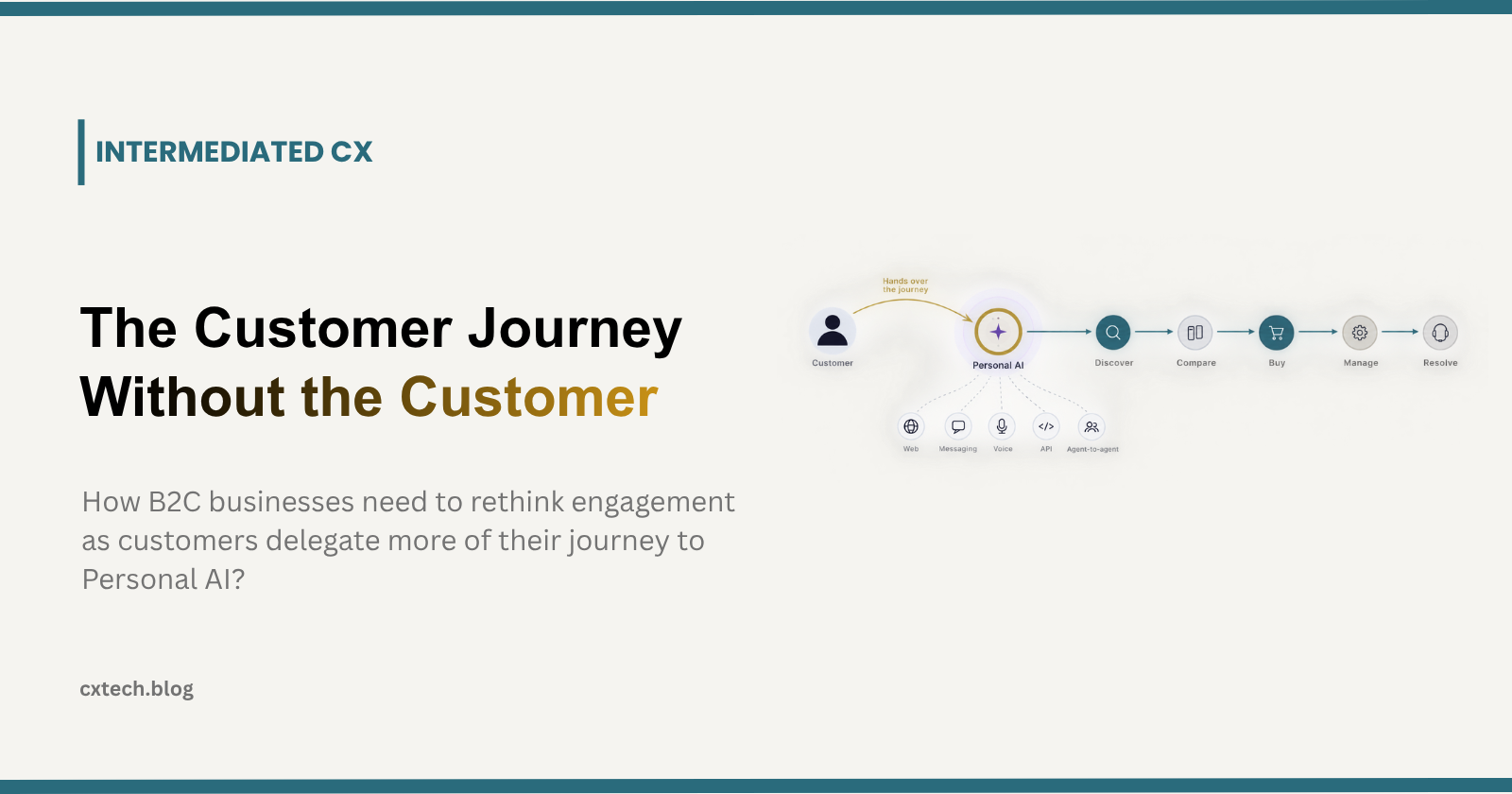
Enterprise AI creates the message → Customer's AI intercepts it → We humans see whatever the AI decided to show us.
This is Intermediated CX. The era of the Agent-in-the-Middle.
Brands are no longer designing for human attention alone. Increasingly, they're communicating with a machine first, and that machine decides how much of the message gets through, in what form, and with what priority.

Two channels where this is already playing out deserve specific attention: email and voice.
The Inbox Gatekeeper
For two decades, email marketing has relied on the curiosity gap, crafting emotionally charged subject lines and preheaders designed to get a human to open the message. That model assumed the human saw the subject line and made a decision.
That assumption is breaking.
Gmail's AI Inbox, currently available to Google AI Plus, Pro, and Ultra subscribers in the US, reads the full body of incoming email and produces two things: a list of suggested to-dos extracted from action items, and topic clusters that group related emails by life context rather than by sender. Apple Mail, since iOS 18.1, generates its own summary of the email body and displays it in the inbox list, regardless of what the sender put in the preheader. Yahoo Mail does the same: an AI-generated one-line summary appears beneath each message in its Priority inbox tab.
None of these features are universal yet. Gmail's requires a paid Google AI subscription (starting at $7.99/month for Plus). Apple's requires an Apple Intelligence-capable device (iPhone 15 Pro or later). Yahoo's is free but desktop-only for now. But the direction is unambiguous, and Twilio's 2025 Email Deliverability Guide quietly acknowledges it: mailbox providers are now extracting data from emails to create summaries in the inbox. The infrastructure vendors are aware. The practical guidance for senders on how to adapt is still catching up.
What actually changes for senders
The shift isn't abstract. It has specific, structural consequences for how emails should be built.
The preheader is no longer guaranteed to show.
Apple Mail's AI replaces your preheader with its own summary, generated from the email body. If the first meaningful content in your HTML is a navigation bar, a logo, or boilerplate legal text, the AI summary will reflect that poorly. The preheader still matters for clients that display it, but it's no longer the only line competing for attention.
Emotional hooks get neutralized.
If a brand sends an email titled "You won't believe what we just unlocked," the consumer's AI may surface: "Promotional email offering 15% off winter boots." The gatekeeper reduces marketing language to literal facts. The curiosity gap doesn't disappear, subject lines still work for the humans who see them, but there's now a second audience reading the same email with no interest in being intrigued.
HTML structure becomes a strategic decision.
AI summaries are generated from the text layer of the email, not from images. Content embedded in hero banners or styled image buttons is invisible to the summarizer. And the AI tends to weight early text most heavily, so if the primary value proposition sits below three rows of header images and navigation links, the summary will be built from whatever text the AI encounters first, which may be boilerplate rather than your offer. Front-loading the key information in the first line of body text isn't a copywriting tip; it's a structural change to how templates are built.
Here's what that looks like in practice:
Before (typical promotional template):
The email opens with a brand logo, a navigation bar, and a hero image containing the offer: "20% off all orders over $100 this weekend." The live text beneath is a generic paragraph about the brand's summer collection. Because the offer exists only as image content, the AI can't see it. The summary might surface something like: "BrandCo summer collection update."
After (restructured for dual audience):
The email opens with a single line of live HTML text above the hero: "20% off orders over $100 this weekend: code SUMMER20." The hero image, navigation, and brand assets follow.
The AI now has a clear, specific text line to work with. The summary is far more likely to surface the actual offer.
Same email. Same creative. The only change is making the key line available as live text in the first position. The human still sees the full designed email. The AI gatekeeper now has something useful to work with.
This is what designing for a dual audience means in practice. You're still writing for the inbox. You're also now prompting the gatekeeper.
The Call Screener
If the email gatekeeper is quietly reshaping outbound marketing, the voice equivalent is doing something louder: it's creating operational deadlock.
Enterprise outbound calling has scaled massively on AI voice agents. Sales development, appointment reminders, collections, patient engagement - AI agents now handle millions of outbound calls daily at a fraction of the cost of human dialers. The technology for generating the call has never been better.
But the technology for answering the call has changed too.
Apple introduced Call Screening in iOS 26. When enabled for unknown numbers, Siri answers the call, asks the caller to identify themselves and state their purpose, transcribes the response, and shows it to the user — all before the phone rings. The user decides whether to pick up based on the transcript. Google Pixel has offered Call Screen since 2018, with the same pattern: the phone's AI answers, interrogates, and transcribes. Samsung shipped automatic call screening in One UI 8.5, replacing its earlier manual Bixby Text Call with an AI that answers, transcribes, and filters without the user touching the phone. Truecaller and Hiya add additional screening, scam detection, and AI-powered call summaries on top.
The consumer's phone is no longer a passive receiver. It's an active gatekeeper, and it's running its own AI.
Where the two AIs collide
Enterprise outbound platforms rely on Answering Machine Detection (AMD) logic that listens to the first few seconds of a call to determine whether a human or a voicemail system answered. Traditional AMD works by detecting a continuous greeting followed by a carrier network beep: the beep signals a voicemail box, and the system either leaves a message or disconnects.
Modern consumer AI screeners don't beep. They answer with a synthesized voice, ask a question, and wait for the caller to respond. There is no greeting-then-beep pattern. There is no carrier signal.
The enterprise bot waits for a beep that never comes. The consumer's screener waits for a voice that never speaks. The customer sees a blank transcript and a missed call. Neither AI accomplished anything.
This isn't a hypothetical edge case. Thoughtly, a voice AI platform, already documents how to make enterprise agents respond correctly to iOS call screening, Android Call Screen, Samsung Bixby Text Call, Truecaller, and Hiya. The collision is happening in production, and platforms that haven't adapted are seeing connect rates degrade with no obvious explanation because the calls are technically being "answered," just not by a human.
What this means architecturally
The immediate fix is tactical: enterprise voice agents need to detect AI screeners (no beep, synthesized greeting, interrogative pattern) and respond with a clear, structured identification of company name, reason for calling, and a request to connect to the human.
Thoughtly's guidance is essentially this: make your bot readable by the other bot.
But the longer-term question is more fundamental. When both sides of a voice call are running AI, the audio channel itself becomes the bottleneck. Two machines talking to each other through synthesized speech, over a lossy audio codec, is an extraordinarily inefficient way to exchange structured information.
The telecom industry has the building blocks for something better. SIP (Session Initiation Protocol), the standard that sets up voice calls, supports User-to-User Information (UUI) headers for metadata that can travel alongside the call setup without being part of the audio stream. In principle, an enterprise dialer could pass a structured payload including company identity, call purpose, and authentication context in the SIP header, and the consumer's device AI could read it, verify it, and present the user with a decision card rather than a transcript of two bots talking to each other.
Nobody may have built this end-to-end in production. It's an architectural direction, not an announced product. But the pieces exist: SIP UUI is a defined standard, Google's Agent-to-Agent (A2A) protocol provides a framework for structured agent coordination, and the consumer-side screeners are already sophisticated enough to act on metadata if it were available. The gap is integration and incentive, not capability.
CX leaders don't need to build for this today. But they should be aware that the current model - enterprise bot talks to consumer bot over audio - is a transitional state, not a destination.
What to do with this
Recognise the dual audience in email. Your email is now read by two entities: the human subscriber and their inbox AI. Template design needs to account for both. Restructure HTML to front-load the primary value proposition in the first line of live text. Keep writing subject lines for humans. Start structuring body content for machines.
Audit your outbound voice stack for screener compatibility. If your AMD logic assumes a beep, it will fail silently against Apple, Google, and Samsung screeners — and the failure will look like a connect rate decline, not an error. Test your voice agents against the major consumer screeners and adapt identification behaviour accordingly.
Track the adoption curve, not just the technology. Gmail AI Inbox requires a paid Google AI subscription (from $7.99/month on Plus). Apple Call Screening is opt-in. Samsung's auto-screens suspected spam by default. Google Pixel has had Call Screen since 2018. Three of the four major device ecosystems now have call screening shipped, and inbox AI summaries are available across Gmail, Apple Mail, and Yahoo Mail. Adoption isn't hypothetical — it's in progress. Planning for full penetration now is cheaper than reacting after it arrives.
Stop assuming the human is the first reader. The Agent-in-the-Middle is the defining shift in outbound CX for the next three years. Every message your brand sends — email, voice, push, SMS — will increasingly pass through a consumer AI before it reaches a person. The brands that design for machine readability alongside human emotion will outperform those that optimise only for the human who may never see the original message.
Earlier posts on this blog have covered WhatsApp's move to usernames and Business-Scoped User IDs, and how email's threading architecture compares to chat channels for multi-topic customer relationships.